Home / Stories / Before Confederation
The Expulsion of the Acadians: Why 11,500 People Were Deported From Their Own Farms in 1755
In 1755 British authorities deported the Acadians, a farming people who had lived in the Maritimes for five generations. The oath they would not swear, the order read aloud in the church at Grand Pré, the ships, the deaths, and the long road home.
The short answer
In 1755, British authorities in Nova Scotia deported the Acadians, French speaking farmers whose families had lived around the Bay of Fundy for five generations, after they refused an unconditional oath of allegiance. About 11,500 people were shipped away between 1755 and 1763, their homes burned and their farms given to other settlers.
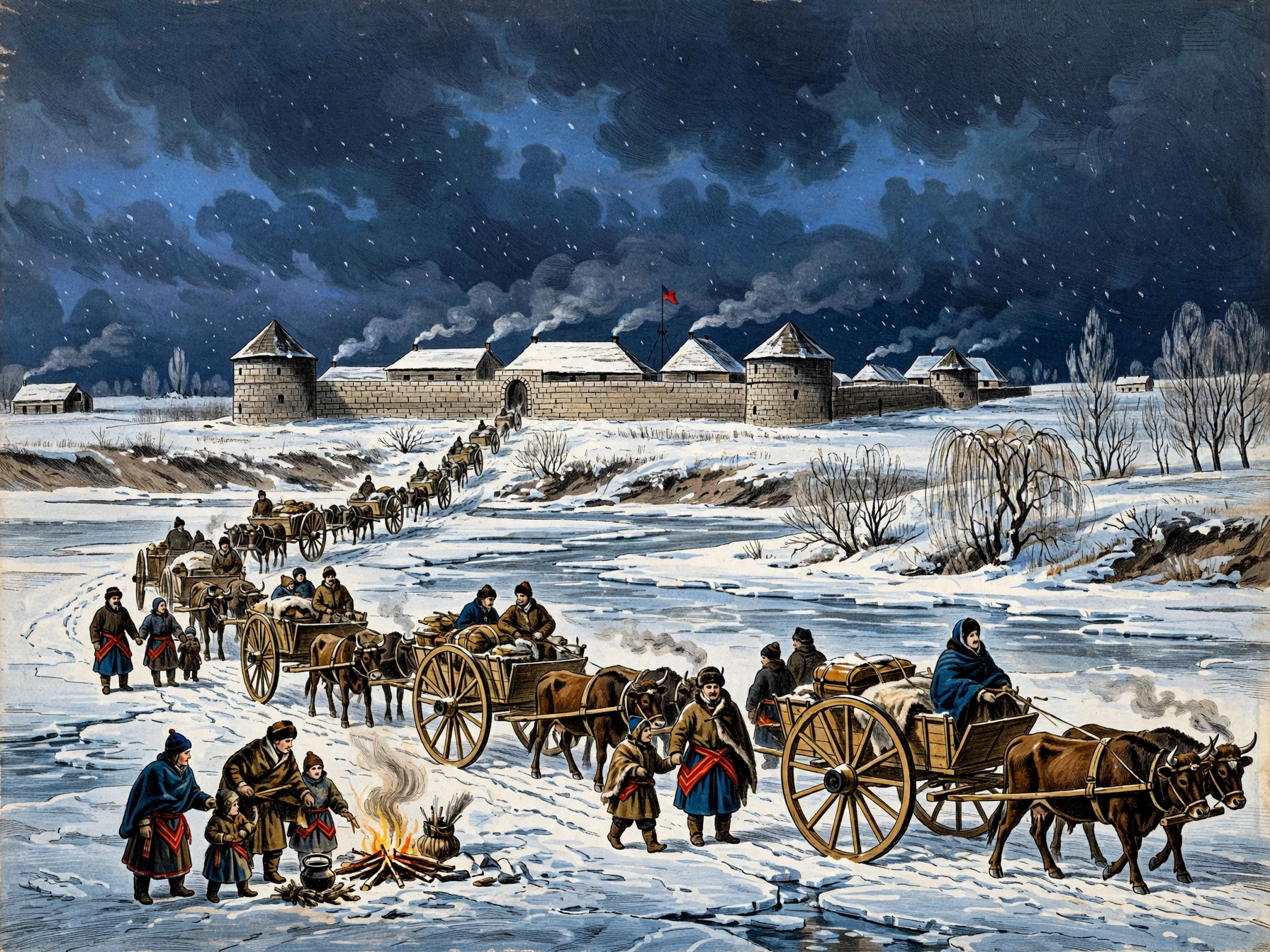
On the fifth of September, 1755, the men and boys of Grand Pré were summoned to their own church. About four hundred and eighteen of them, fathers and sons down to boys of ten, filed into the church of Saint Charles des Mines, where British soldiers stood at the doors. Lieutenant Colonel John Winslow, a New England officer in British service, had a table set before the altar, and from it he read the order that ended their world. Their lands and houses, their cattle and livestock, were forfeit to the Crown. They themselves were to be removed from the province. What happened at Grand Pré was repeated, with variations, across the whole of Acadie. Historians now count about 11,500 Acadians deported between 1755 and 1763, out of a people who numbered perhaps 14,000 to 18,000 in all. The numbers are debated at the edges, but the shape of the event is not debated at all. A government removed nearly an entire people from land their grandparents had farmed, at bayonet point, and scattered them across an ocean.
A people who drained the sea
The Acadians were not newcomers caught in someone else’s war. Their ancestors had come from France beginning in the 1630s and 1640s, settling first at Port Royal and then spreading around the Bay of Fundy, to Beaubassin near the isthmus, to Pisiquid, Cobequid, and Grand Pré. By 1755 many families had been on the same land for five generations. They had never lived in France.
What they built explains why their farms were coveted. The Fundy tides, the highest on Earth, flooded rich salt marshes twice a day. The Acadians answered with dykes, great earthen walls fitted with sluice gates called aboiteaux, wooden valves that let fresh water drain out at low tide and slammed shut against the salt water as the tide returned. Behind those walls, rain washed the salt from the soil, and within a few years a family gained fields of extraordinary fertility, with cattle grazing the outer marshes. Villages ran themselves through deputies chosen from among the farmers, and the Acadians built lasting relations with the Mi’kmaq, their neighbours and frequent kin by marriage, an alliance that British officials viewed with deep suspicion.
The oath they would not swear
The legal trap closed in 1713. By the Treaty of Utrecht, France ceded peninsular Acadie, which Britain renamed Nova Scotia. The Acadians became British subjects without moving an inch, under a Protestant king an ocean away, while a French Catholic fortress stood within sight across the water.
From then on, everything turned on an oath. British governors demanded unconditional allegiance, which meant, in the event of war, taking up arms for Britain, potentially against France, the Mi’kmaq, and their own relatives. The Acadians refused that version for forty years, and their refusal was a coherent position, not mere stubbornness. They proposed an oath of neutrality instead, faithful subjects who would obey the laws but not bear arms against the French or the Mi’kmaq. In 1730 Governor Richard Philipps accepted a version of that bargain, with a verbal assurance of exemption from bearing arms, and the people who accepted it became known as the French Neutrals.
The bargain corroded as the imperial contest sharpened. Louisbourg fell to New Englanders in 1745 and was handed back by treaty in 1748, and Halifax was founded in 1749, bringing British settlers hungry for farmland into the heart of the peninsula. A minority of Acadians did aid French forces over the years, as guides, suppliers, and occasionally fighters, and officials increasingly treated the whole people as a disguised enemy army. Yet the great majority held to the neutrality they had promised, a fact recorded even by some of the officers who would later deport them. By 1755, with a new war already burning on the continent though not yet formally declared, the Acadians were given a final choice. Swear the oath without conditions, or lose everything.
The summer the decision was made
In June 1755 a British and New England force captured Fort Beauséjour, the French post at the isthmus, and found some Acadians inside the walls, in arms. The Acadians said they had been compelled by the French garrison, which was likely true in part, but the discovery poisoned the last well of official trust. Acting Governor Charles Lawrence summoned Acadian deputies to Halifax and put the unconditional oath to them directly. The deputies refused it and manoeuvred for the old exemption, misreading, fatally, how far the ground had moved. Lawrence and his council, meeting on 28 July 1755, resolved that the Acadians would be deported and their lands forfeited. No order from London directed the expulsion, and none was sought. The decision was made in Halifax.
Then came the machinery. Through August and September, troops moved into the settlements. At Grand Pré, Winslow played the church summons described above, and similar scenes played out at Pisiquid and elsewhere. At Beaubassin, many families escaped into the woods or fled toward French held shores, beginning years of flight and guerrilla resistance led in part by Joseph Broussard, called Beausoleil. Elsewhere the trap worked as designed. Villages were emptied onto ships, houses and barns were burned in view of the departing families so that return would find nothing, and cattle were confiscated. More deportations followed in waves, from Île Saint Jean in 1758 after Louisbourg fell again, and along the St. John River and the Gulf shore, until 1763.
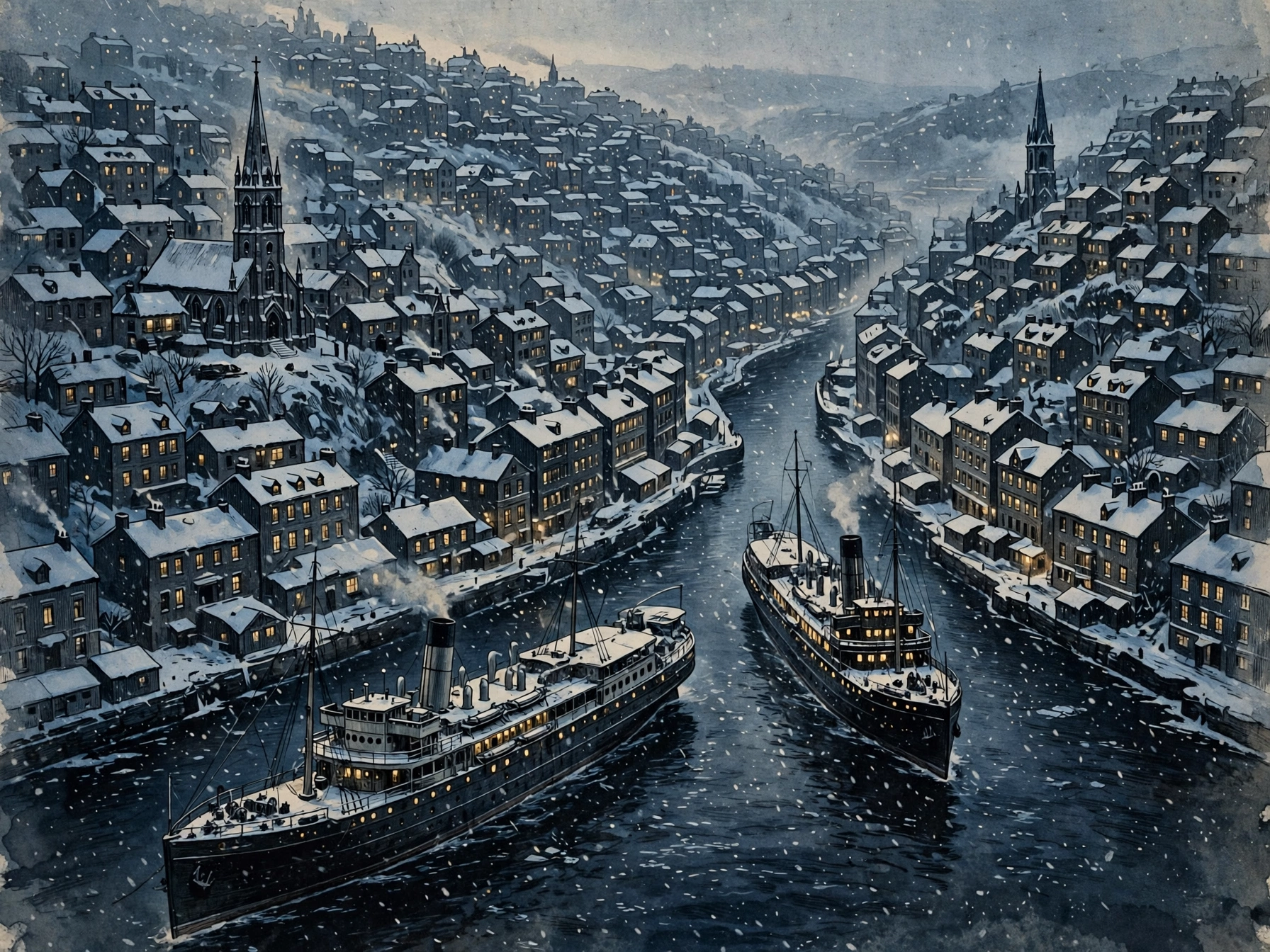
The ships deserve plain language. Transports were overcrowded, provisions were short and often spoiled, and disease, above all smallpox and typhus, moved through the holds. Historians’ estimates of Acadian deaths across the whole expulsion, from disease, drowning, and deprivation, range widely, commonly from about 3,000 to 5,000 people, and any honest account should give the range rather than a single clean figure. Other families were held as prisoners in England for years, or landed in colonies that had not asked for them, where children were separated from parents. The lists were made by village. The ships were filled by space. Husbands, wives, and children boarded different vessels in the same week and spent years trying to find one another again.
Where the deported went, and what they became
The geography of the scattering is the geography of the modern Acadian world. The first waves of 1755 were dumped along the Atlantic seaboard of the Thirteen Colonies, from Massachusetts to Georgia, where reception ranged from cold charity to open hostility. After 1758, transports went increasingly to France itself, to ports such as La Rochelle, Rochefort, and Nantes, where thousands of people who had never seen France lived on Crown allowances in a country that was legally their ancestral home and experientially foreign.
The most famous branch grew in Louisiana. Beginning in 1765, and in larger organized parties in 1785 when seven ships carried about 1,600 Acadians from France, exiles made their way to Spanish ruled Louisiana, where officials wanted Catholic settlers and offered land along the bayous west of New Orleans. Over generations their name wore down in English mouths from Acadian to Cajun. Cajun culture, its music, its foodways, its French language held against long pressure, is the direct inheritance of the deportation, a culture built by refugees on the far side of a continent from the dykes their families had raised.
And some Acadians came back. After 1763, survivors were permitted to return to the Maritimes, but not to their farms. The dyked lands of Grand Pré and Beaubassin had been granted to New England settlers, the Planters, whose descendants hold them still. The returnees started again on marginal land, along the rocky French Shore of Nova Scotia, in southeastern and northern New Brunswick, in pockets of Prince Edward Island and Cape Breton, and in the Magdalen Islands. The deportation had failed at its object. The people it meant to dissolve had instead multiplied their homelands.
The legend vs. the record
The legend here is a poem. In 1847 the American writer Henry Wadsworth Longfellow published Evangeline: A Tale of Acadie, the story of a bride separated from her beloved Gabriel on their wedding day by the deportation, who searches the American wilderness for him all her life and finds him at last, dying, in a Philadelphia almshouse. It became one of the most beloved poems in the English speaking world. Evangeline statues rose at Grand Pré and in Louisiana, tourists came by train to see the willows, and for millions of readers the poem was the expulsion.
The record requires three corrections, delivered with respect, because the poem also preserved a memory the archives might have let fade. First, Evangeline and Gabriel are Longfellow’s creations, built from a story relayed to him at second hand. No deportation record contains their story as told. Second, the poem softens the event into melancholy fate, gentle farmers swept away by the impersonal machinery of empires. The record is harder. Named officials chose the deportation in a council chamber, soldiers burned villages deliberately, and Acadians were not passive. They petitioned, negotiated, evaded, escaped, and in places fought a guerrilla war for years. Third, the numbers. Poetic tellings often inflate the deaths or shrink the event to a single autumn. The careful record is the range given earlier, about 11,500 deported between 1755 and 1763 from a population of 14,000 to 18,000, with deaths in the thousands, sources and methods varying by historian. The true scale is damning enough without decoration.
One more legend deserves a sentence, the notion that London ordered the expulsion and Halifax merely obeyed. The record points the other way. Lawrence acted on his own authority and presented the deportation to London largely as a settled matter, and the British government, busy with a world war, acquiesced rather than ordering it in advance.
Why it still matters
The expulsion is not a closed file in the Maritimes. It is a founding trauma of a living people, marked every twenty eighth of July by a day of commemoration, and it sits inside the landscape. The Landscape of Grand Pré became a UNESCO World Heritage Site in 2012, honoured for the dyking system itself, farmland still drained on the Acadian pattern and now farmed by descendants of the Planters who replaced them. The land remembers the engineers its government expelled.
In December 2003 a royal proclamation issued in the name of Queen Elizabeth II formally acknowledged the wrongs suffered by the Acadians during the expulsion and designated the annual day of commemoration. It stopped short of a formal apology, a distinction Acadian organizations noted carefully, but it placed the Crown’s name on a fact its officers had long left to poets and descendants to carry. Around the Atlantic world, the descendants of 1755 still find each other at Congrès mondial acadien gatherings that rotate among Louisiana, France, and the Maritimes, where a surname on a deportation list can still start a conversation between strangers who turn out to be kin.
The story matters beyond Acadie as a study in how such things happen. No ancient hatred explains 1755. It took a legal pretext in an unsworn oath, a frightened wartime administration, land hunger among respectable settlers, a few hundred reluctant men found inside a captured fort, and a council that chose the sweeping solution because a sweeping solution was available. The Acadians had committed no crime a court ever named. They had refused to promise to fight their cousins, and they were sitting on the best farmland in the region, in the way of an empire at war. Those ingredients are not antique.
Common questions
How many Acadians were deported during the Expulsion?
Historians count about 11,500 Acadians deported between 1755 and 1763, out of a total population of perhaps 14,000 to 18,000. The deportations began at Grand Pré and other Bay of Fundy settlements in 1755 and continued in waves, including from Île Saint Jean in 1758, until 1763.
Why were the Acadians deported in 1755?
British officials demanded an unconditional oath of allegiance, which would have required Acadians to fight for Britain against France and the Mi'kmaq. The Acadians offered neutrality instead. After some Acadians were found inside the captured Fort Beauséjour, Acting Governor Charles Lawrence and his council decided on July 28, 1755 to deport them and seize their land.
Who ordered the Expulsion of the Acadians?
The decision was made in Halifax, not London. Acting Governor Charles Lawrence and the Nova Scotia council resolved on the deportation on July 28, 1755, acting on their own authority. No order from the British government directed the expulsion, and none was sought. London later acquiesced once the deportation was already underway.
Where did the deported Acadians end up?
The first waves were dumped along the Atlantic coast of the Thirteen Colonies, from Massachusetts to Georgia, and later transports went to France. Beginning in 1765, exiles made their way to Spanish Louisiana, where their descendants became the Cajuns. After 1763, some survivors returned to the Maritimes, but not to their original farms.
Sources
Every story on this site ends with the sources it was built from. Check us.
- Acadian Expulsion (The Great Upheaval) — The Canadian Encyclopedia
- Acadians — The Canadian Encyclopedia
- Grand-Pré National Historic Site — Parks Canada
- Grande-Pré — Canada's History
- Charles Lawrence — The Canadian Encyclopedia