Home / Stories / War, Hard Times, and Rights
The Halifax Explosion: The Morning a Ship Blew Up a City
On December 6, 1917, a collision in Halifax Harbour touched off the largest explosion of the age, killing 1,782 people and remaking a city.
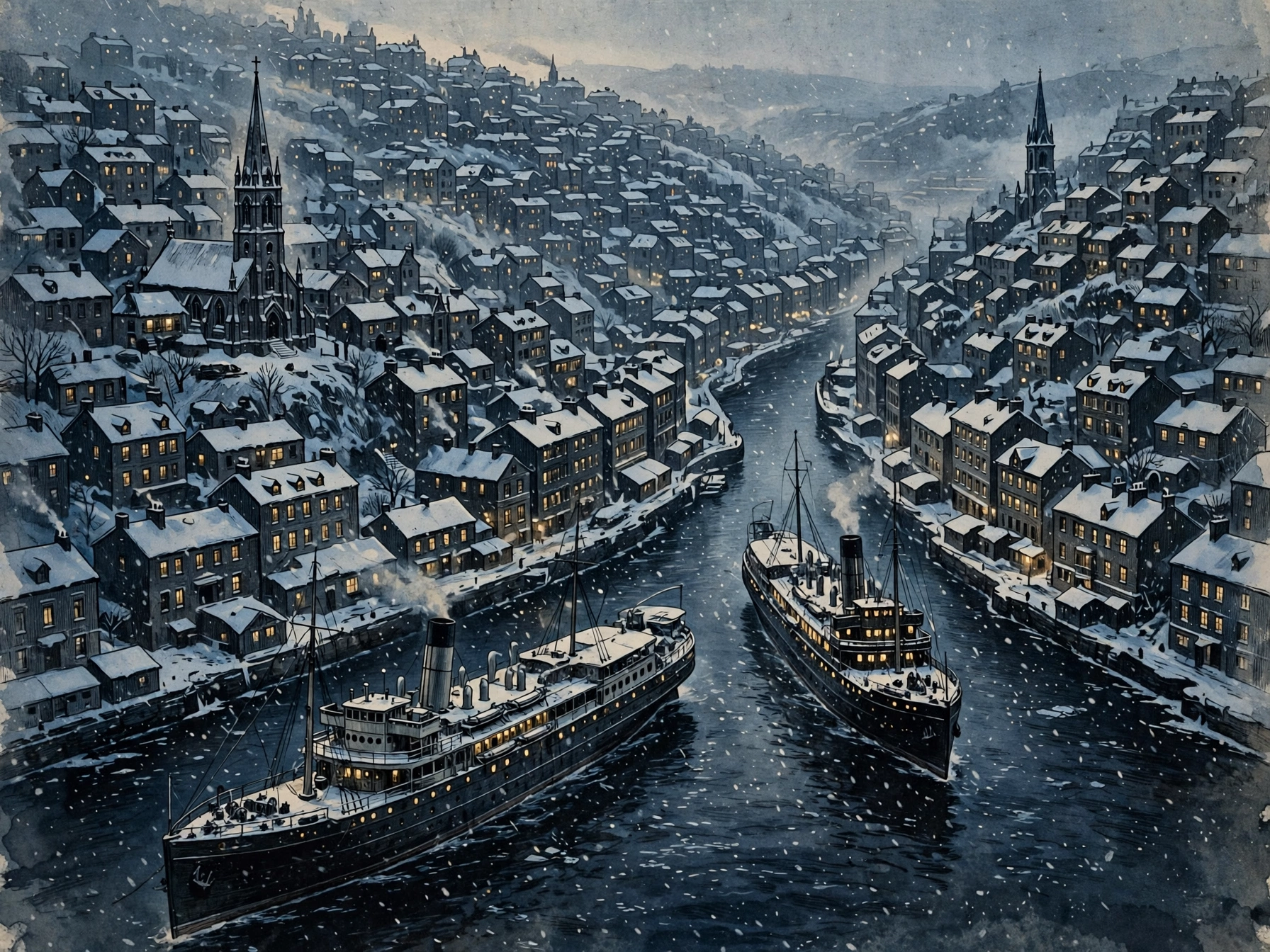
The morning of December 6, 1917 was cold, clear, and calm in Halifax, the kind of bright winter morning when the harbour lay flat and every sound carried across the water. Shortly before nine o’clock, crowds began to gather along the waterfront in the Richmond district at the north end of the city. They were watching a ship burn. A French freighter was drifting toward Pier 6 with flames climbing from its deck, and people came out of houses, schools, factories, and trains to look. Children on their way to school stopped on the hillside. Workers leaned from windows. Almost none of them knew what the ship was carrying, and the few who did know were running in the other direction. The burning ship had about twenty minutes left to drift, and the city, without knowing it, had about twenty minutes left of the world as it had been that morning.
A wartime port at full stretch
Halifax in 1917 was a city doing a job far bigger than itself. Canada had been at war with Germany for more than three years, and Halifax was the country’s great Atlantic port, the place where convoys gathered before crossing an ocean patrolled by German submarines. Troop ships, hospital ships, freighters, and warships crowded the harbour and Bedford Basin. Soldiers heading overseas passed through the city in the tens of thousands, and the population had swollen well past its peacetime size. Ships arrived loaded with everything a war consumes, including explosives, and they moved through the harbour under rules meant to keep a crowded port safe.
Those rules mattered on the morning of December 6 because two ships were moving through the Narrows, the tight stretch of water between Halifax and Dartmouth, at the same time and, in effect, toward each other. The Norwegian vessel Imo was leaving harbour in ballast, bound for New York to load relief supplies for Belgium. Coming the other way was the French freighter Mont Blanc, newly arrived from New York and waiting to join a convoy. Mont Blanc was, in the plainest sense, a floating bomb. Her holds were packed with explosives, including picric acid and TNT, with barrels of benzol fuel lashed on her deck. She carried close to 3,000 tons of explosive material in total. Because of the submarine threat she flew no warning flag, so nothing about her appearance told the city what she was.
The collision in the Narrows
The disaster began as a dispute about right of way in a narrow channel. Through a sequence of signals, whistle blasts, and late decisions that investigators would argue over for years, Imo and Mont Blanc ended up on a collision course in water where there was little room to correct a mistake. At about 8:45 in the morning, Imo’s bow cut into Mont Blanc’s side. The impact was not, by itself, a catastrophe. The damage to the French ship was survivable, and both vessels might have limped away from an ordinary accident. What made it fatal was what happened on Mont Blanc’s deck, where the collision knocked over benzol barrels and spilled fuel, and sparks from the grinding hulls set the fuel alight.
Fire on any ship is an emergency. Fire spreading toward thousands of tons of explosives was a death sentence with a short fuse, and Captain Aimé Le Médec and his crew understood that at once. They launched their boats and rowed hard for the Dartmouth shore, shouting warnings in French and English that few onlookers understood or believed. The pilot, Francis Mackey, went with them. Left to drift, Mont Blanc burned for about twenty minutes and swung slowly toward the Halifax shore, coming to rest against Pier 6 in Richmond, the city’s busy working district of homes, schools, churches, rail yards, and factories. The fire drew spectators the way fires always do. It also set fire to the pier and nearby buildings before the cargo itself went up, which spread confusion about what kind of danger people were standing in.
One man understood it exactly. Vincent Coleman was a train dispatcher working in the Richmond rail yard, a short distance from the pier. When word reached him that a burning ammunition ship was coming ashore, he started to leave with a colleague, then turned back. An overnight express train from Saint John, carrying hundreds of passengers, was due into the city and would pass straight through the yard. Coleman sat down at his telegraph key and sent a message up the line: “Hold up the train. Ammunition ship afire in harbour making for Pier 6 and will explode. Guess this will be my last message. Good bye boys.” The train stopped safely at Rockingham, well short of the yard. Coleman died at his post.
9:04
At 9:04 in the morning, Mont Blanc exploded. It was the largest explosion human beings had ever caused, and it held that grim record until the atomic age. The ship simply ceased to exist. A column of smoke and fire rose thousands of metres into the air. The blast flattened Richmond and devastated the north end of Halifax, destroying more than 1,600 homes and damaging thousands of buildings. Windows broke in Truro, more than 90 kilometres away. Pieces of the ship fell across both shores of the harbour, and her anchor shaft landed kilometres from the pier.
The numbers, assembled over the following days from ruins and lists of the missing, were staggering. The official count recorded 1,782 people killed, and historians have long noted that the true figure may be somewhat higher, since some victims, including residents of the Mi’kmaq settlement at Tufts Cove, were never fully counted. About 9,000 people were injured, many of them blinded or cut by flying glass, because hundreds had been standing at windows watching the fire when the blast drove the glass inward. Roughly 25,000 people were left homeless or without adequate shelter in a Nova Scotia winter. Entire streets in Richmond were erased. Schools, churches, and factories collapsed on the people inside them. On the Dartmouth side, the Tufts Cove community was destroyed by both the blast and what followed it.
The wave, the snow, and the train from Boston
The explosion pushed the harbour itself onto the land. A wave tore up from the Narrows, sweeping over both shores, carrying wreckage and people with it, and drowning survivors of the blast who had reached the water’s edge. It struck Tufts Cove with particular force. Then, as if the day had not finished, the weather turned. On December 7 a fierce blizzard buried Halifax under roughly 40 centimetres of snow. The storm blocked roads and rail lines, collapsed weakened roofs, and made rescue work slower and crueller. It also, paradoxically, helped smother the fires still burning in the ruins.
Help came anyway, from across Canada and, most famously, from Boston. Massachusetts had strong ties to the Maritimes, and a relief train loaded with doctors, nurses, and supplies left Boston on the evening of December 6, fought through the same storm, and reached Halifax on December 8. Medical teams from Boston worked in the city for weeks. The official inquiry that followed blamed errors by both ships, and criminal charges arising from it were eventually dropped or dismissed. The argument over fault ran on through the courts for years, ending with both vessels held to share the blame. Halifax, meanwhile, rebuilt. On the flattened slope of Richmond rose the Hydrostone district, a planned neighbourhood of stone faced houses along tree lined boulevards, designed after the disaster and still one of the most admired neighbourhoods in the city.
The legend vs. the record
The best known legend needs no correction, only precision. Vincent Coleman really did stay, really did send that message, and really did die doing it, and the incoming train really did stop in time. His words survive in the record almost exactly as they are quoted. If anything, the record is stronger than the legend, because Coleman was not ordered to stay. He had already started to leave when he went back to the key.
Other parts of the legend deserve a firmer hand. The explosion is often described as an act of war or the result of German sabotage, and rumours of spies circulated within hours. The record shows an accident, produced by a chain of navigational mistakes, wartime congestion, and a cargo that turned a routine collision into a catastrophe. No evidence of sabotage has ever been found. The death toll also needs honesty. The figure of 1,782 is the official count, not a complete one, and responsible accounts say so. Finally, the disaster is sometimes told as a story only about Halifax. The record includes Dartmouth and Tufts Cove, where a Mi’kmaq community was destroyed and largely written out of early accounts. The full record is wider, and sadder, than the famous version.
Why it still matters
The Halifax Explosion remains the worst disaster in Canadian history, and the city still lives inside its geography. The Hydrostone still stands. The harbour still narrows between the same two shores. Every December 6, Halifax pauses, and every year Nova Scotia sends a great Christmas tree to Boston in thanks for the train that came through the snow in 1917, a tradition renewed annually since 1971. The disaster also changed how ports handle dangerous cargo and how Canada responds to catastrophe. Most of all, it endures because of what it asks of ordinary people. A dispatcher sat back down at a telegraph key. Strangers dug in frozen ruins. A city in another country loaded a train. The record of December 6 is a record of a bomb that no one meant to drop, and of the people who answered it.
Sources
Every story on this site ends with the sources it was built from. Check us.
- Halifax Explosion — The Canadian Encyclopedia
- Vincent Coleman — The Canadian Encyclopedia
- The Halifax Explosion — Canadian War Museum
- Halifax Explosion — Library and Archives Canada
- Remembrance: The First World War — Veterans Affairs Canada